In April 2, 1917 President Wilson asked Congress to declare war on
Germany. "The world," he said, "must be made safe for democracy."
Quickly, Americans swung into action to raise, equip, and ship the
American Expeditionary Force to the trenches of Europe. Under the powers
granted to it by the U.S. Constitution, Congress passed the Selective Service Act of 1917.
Among the first regiments to arrive in France, and among the most highly
decorated when it returned, was the 369th Infantry (formerly the 15th
Regiment New York Guard), more gallantly known as the "Harlem
Hellfighters." The 369th was an all-black regiment under the command of
mostly white officers including their commander, Colonel William
Hayward.
In April 2, 1917 President Wilson asked Congress to declare war on
Germany. "The world," he said, "must be made safe for democracy."
Quickly, Americans swung into action to raise, equip, and ship the
American Expeditionary Force to the trenches of Europe. Under the powers
granted to it by the U.S. Constitution, Congress passed the Selective Service Act of 1917.
Among the first regiments to arrive in France, and among the most highly
decorated when it returned, was the 369th Infantry (formerly the 15th
Regiment New York Guard), more gallantly known as the "Harlem
Hellfighters." The 369th was an all-black regiment under the command of
mostly white officers including their commander, Colonel William
Hayward.Participation in the war effort was problematic for African Americans. While America was on a crusade to make the world safe for democracy it was neglecting the fight for equality at home. Plessy v. Ferguson (1896) established that the 14th Amendment allowed for separate but equal treatment under the law. In 1913 President Wilson ordered the segregation of federal office workers. The U.S. Army at this time drafted both black and white men, but they served in segregated units. After the black community organized protests, the Army finally agreed to train African American officers but it never put them in command of white troops. Leaders of the African American community differed in their responses to this crisis. A. Philip Randolph was pessimistic about what the war would mean for black Americans -- he pointed out that Negroes had sacrificed their blood on the battlefields of every American war since the Revolution, but it still had not brought them full citizenship. There were arguments that there shouldn't be segregation between.

http://www.blackpast.org/aah/369th-infantry-regiment-harlem-hellfighters
http://www.archives.gov/education/lessons/369th-infantry/

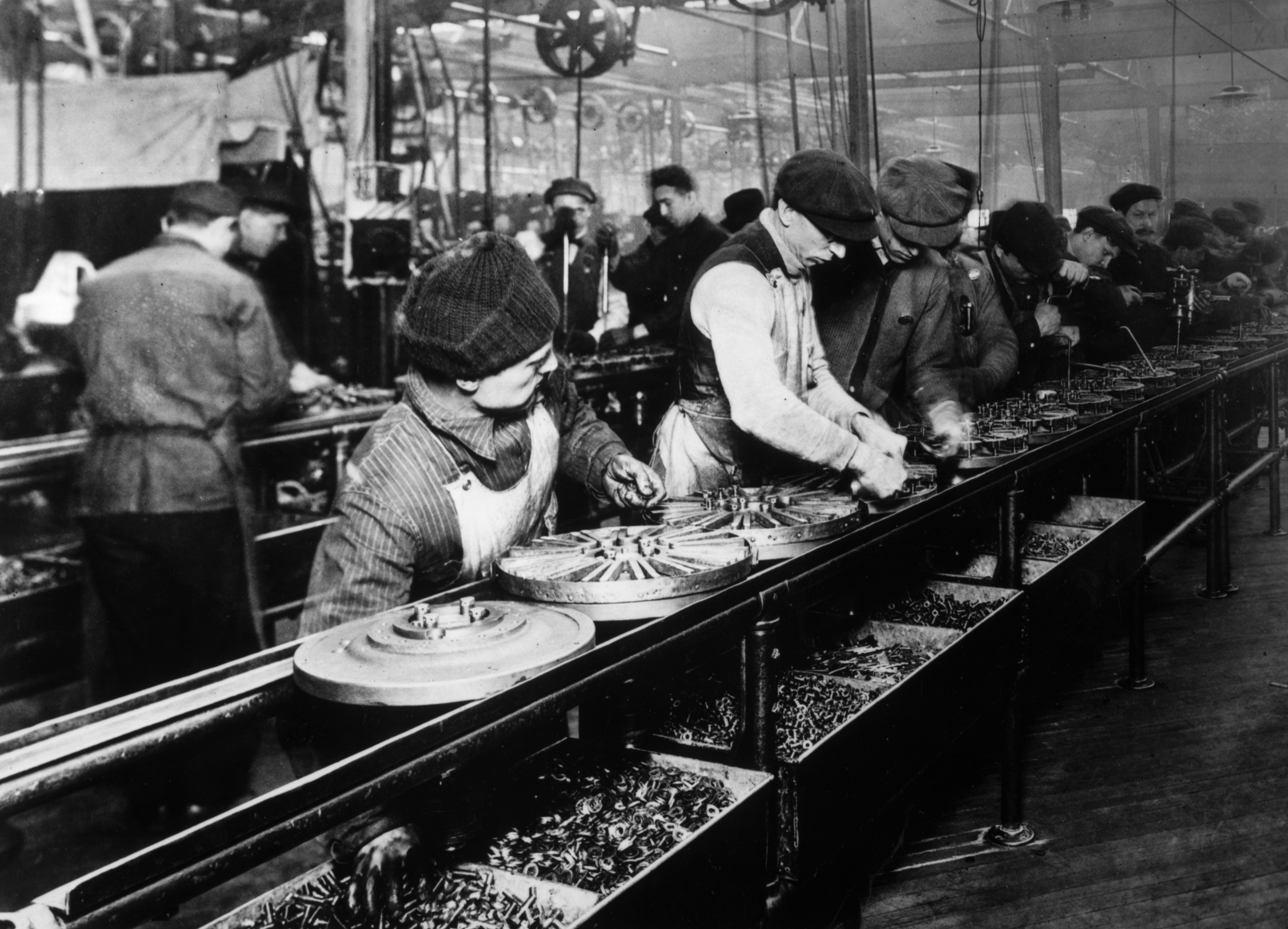
 The Ford Model T, also known as Tin Lizzie, T-Model Ford, 'Model T Ford or just T, was an automobile that was made by Henry Ford from October 1, 1908 to May 27, 1927. Henry Ford changed the world by using the assembly line technique to produce a car affordable for everyone. Ford's use of the assembly line had increased production speed from 12 hours and 8 minutes to one hour and 33 minutes. By 1927 an automobile was being manufactured every 27 seconds.